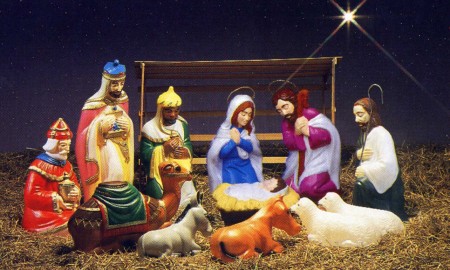
It shouldn't surprise us that the distracting trappings and customs of American Christmas last past Dec. 25. But here's an interesting post from Dr. Ben Witherington:
While Americans are busily treating Dec. 26th as ‘exchange day’ when they take unwanted Christmas presents back to the stores and exchange them for something they like better, the British, and other nations in the British Commonwealth (and other European nations) are busily celebrating Boxing Day.
You can read the rest here.
Monday, December 30, 2013
Friday, December 27, 2013
Friday Fun: Hipster Santa
Monday, December 23, 2013
Christmas's Three "S" Taboos
This was posted last year, but it's a good reminder!
It’s difficult, if not impossible, to overstate the significance of the Incarnation.
Writers, philosophers, poets, and composers through the centuries have searched in vain for words that adequately capture the wonder, mystery, beauty, and power of Jesus as Emmanuel, God with us.
The miracle and meaning of the Incarnation can be so difficult to grasp that we can give up and start to view Christmas in ways that leave us impoverished and unimpressed with the real story. Even in the church our songs and reflections about about Christmas can fail to leave people gasping in amazement or humbled in awe that God would come to dwell among us.
You can read the rest here. HT: Bob Kauflin at Worship Matters
Friday, December 20, 2013
Friday Fun: Taylor University's Silent Night
This is the last year I'll be posting about this creative sports tradition that takes place in a small little Christian college in rural Indiana.
You can read about it here.
Enjoy the video!
Thursday, December 19, 2013
Rethinking Nativity Scenes?
In case you haven't heard, nativity scenes aren't accurate. But at least I learned it incrementally. In my Christian grade school, I learned that the original Christmas didn't take place during the winter and that the wise men weren't there when Jesus was a newborn. The president of my undergrad believes Jesus's birth took place in a cave, and I recently was tipped to this article, which flies into the face of almost everything else about nativity scenes, some Christmas pageants and the lyrics of several Christmas carols.
So there were no wise men or stable, and the animals may have been only present intermittently. But I'm not going to keep my toddlers from playing with their newly-given (thanks, Memaw and Gipa!) nativity set from Fisher Price. Because there are some things that nativity sets get right:
Jesus was born in a humble place. A peasant home that included the stench of animals. He was laid in a container where animal food is delivered. You can keep the stable. The significance of Jesus's birth, despite its lowly setting, transcended culture, political status and income level. Keep the "three kings." Jesus's birth was overseen and celebrated by angels. Keep the singing angel above the non-existent stable.
An historically accurate nativity seen would look a bit different, much less an historically accurate Christmas pageant. Learning about the true story of Christmas as read in the Scriptures should challenge us time and time again to see how much tradition and otherwise has spilled into what we see as Truth.
At the same time, the secondary historical details aren't as important as the truthful symbolism of the transcendent gospel. Even if the typical nativity scene was historically accurate, should we recall or boycott the international nativity scenes that don't give nods to secondary details of historical accuracy yet fully convey the symbolism of the gospel?
So there were no wise men or stable, and the animals may have been only present intermittently. But I'm not going to keep my toddlers from playing with their newly-given (thanks, Memaw and Gipa!) nativity set from Fisher Price. Because there are some things that nativity sets get right:
Jesus was born in a humble place. A peasant home that included the stench of animals. He was laid in a container where animal food is delivered. You can keep the stable. The significance of Jesus's birth, despite its lowly setting, transcended culture, political status and income level. Keep the "three kings." Jesus's birth was overseen and celebrated by angels. Keep the singing angel above the non-existent stable.
An historically accurate nativity seen would look a bit different, much less an historically accurate Christmas pageant. Learning about the true story of Christmas as read in the Scriptures should challenge us time and time again to see how much tradition and otherwise has spilled into what we see as Truth.
At the same time, the secondary historical details aren't as important as the truthful symbolism of the transcendent gospel. Even if the typical nativity scene was historically accurate, should we recall or boycott the international nativity scenes that don't give nods to secondary details of historical accuracy yet fully convey the symbolism of the gospel?
Wednesday, December 18, 2013
Jesus, Santa, District 11 and Race
Interesting thoughts.
My elder daughter loves the Santa Claus story (especially where Rudolph enters the scene), but she knows it only as a fictional tale. She’s told that the presents she receives on Christmas morning are from her family, not from a man who slides down the chimney our house doesn’t actually possess. For my girls, Santa takes his place in a milieu of imaginary characters along with Cinderella and Winnie the Pooh and the cast of Dinosaur Train.
Yet it is troubling to me how easily angered so many people are by the mere suggestion of a non-white Santa. It reminds me of the upset caused by Rue in The Hunger Games; though Collins describes the character’s “satiny brown skin,” some viewers of the film were astonished and outraged that the tributes from District 11 were portrayed by black actors. Both scenarios speak to racial privilege as powerful even within the imaginary realm—that even characters described by their creators as non-white can be assumed white. In both the discussion of Santa and Rue, there’s also the underlying belief that a white character is somehow universal while a person of color can only represent or speak to another person of color. It’s not just that Santa is most frequently depicted as white, it’s that so many people simultaneously insist on his whiteness as essential and obvious without recognizing what that says about how much race actually matters to us.
You can read the rest here. HT: Erin Wyble Newcomb
Tuesday, December 17, 2013
Have a Mighty Christmas
One of my most creative and theologically-minded informed me about Ace Collins, an author whose books include historical background to popular Christmas carols. Below are excerpts from when we was interviewed regarding "God Rest Ye Merry, Gentlemen."
"I wanted to find out what “rest” meant in the Old English language. It did not mean 'sleep.' It meant 'make' or 'keep'—'God Make You Merry, Gentlemen.' But there was something else I wanted to find out. I figure, 'If the word ‘rest’ meant something different, maybe, ‘merry’ meant something different. Maybe, it wasn’t Robin Hood and his ‘happy’ guys out in the forest. Sure enough, it wasn’t. 'Merry'—in the 1500’s and 1600’s, when this song was written—meant 'mighty'—'mighty' or 'great.' Think of the song this way: 'God make you mighty, gentlemen. Let nothing you dismay. Remember Christ your Savior was born on Christmas Day.' So, rather than saying: 'Happy Christmas,' or, 'Merry Christmas,' to each other this year, we need to be saying: 'Mighty Christmas,' 'Have a Mighty Christmas,'—'Have a powerful Christmas,'—'Have a great Christmas!' That’s what that song means. That song, which we kind of almost discredit in modern-day usage, has a very, very powerful meaning that we’ve lost."
You can read more about Ace Collins here.
Subscribe to:
Posts (Atom)